

When a child is in the middle of a trauma reminder response, their brain shifts into survival mode — and in that moment, complex language, explanations, and instructions don’t reach them. What does reach them is your calm presence and a few short, grounding phrases that signal: you are here, they are safe, and nothing is required of them right now.
That’s the whole framework. Everything below builds on it.
What Is a Trauma Reminder Response?
According to the National Child Traumatic Stress Network (NCTSN), traumatic experiences leave a lasting legacy of reminders. These reminders can be linked to aspects of the traumatic experience itself — its circumstances, sounds, smells, physical sensations, anniversaries — and can reactivate the trauma response long after the original event has ended.
This is not misbehavior. It is a nervous system response. Understanding that distinction changes everything about how you respond.
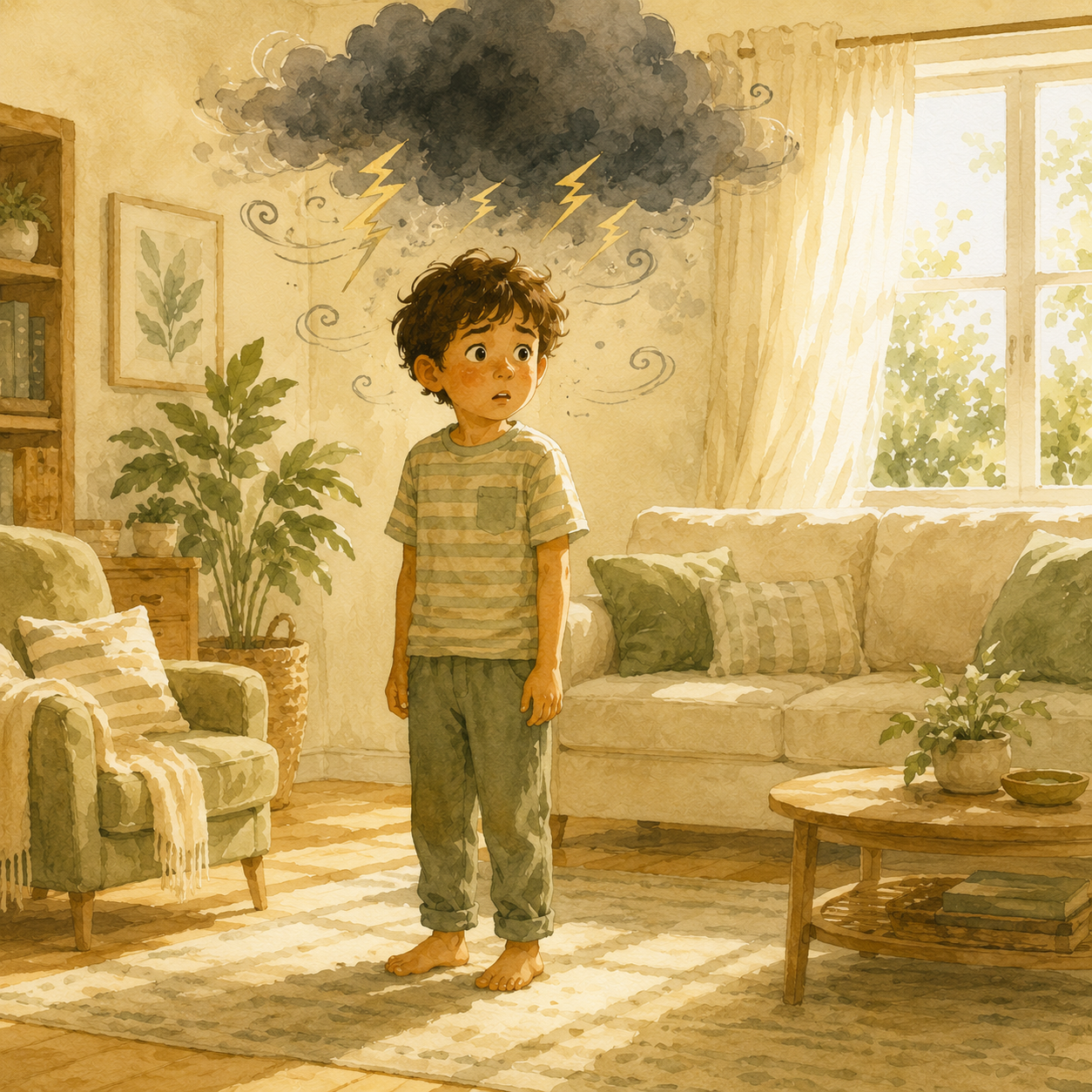
What a Trauma Reminder Response Looks Like
A child in a trauma reminder response doesn’t always look visibly distressed. Sometimes it looks like a child who is simply “acting out.” According to the Child Mind Institute, children with trauma histories may:
- Lash out suddenly with aggression or anger
- Shut down completely and go silent or still (freeze response)
- Become intensely clingy or refuse to separate
- Have an exaggerated startle response to loud sounds or sudden movements
- Regress to earlier behaviors — baby talk, bedwetting, thumb-sucking
- Complain of stomachaches or headaches with no clear physical cause
- Seem “out of nowhere” tearful, panicked, or inconsolable
The behavior that looks defiant, disrespectful, or manipulative is often a child’s nervous system doing exactly what it was designed to do: protect them from a perceived threat. The child is not choosing this response any more than they would choose to flinch if something flew at their face.

Why “Calm Down” Doesn’t Work
When a child is in the middle of a trauma reminder response, their brain’s prefrontal cortex — the part responsible for reasoning, language processing, and decision-making — is essentially offline. The amygdala, the brain’s alarm system, has taken over.
This means that in that moment, your child literally cannot process complex sentences, multi-step instructions, or logical explanations. The words “calm down,” “stop overreacting,” and “you need to control yourself” not only don’t land — they can actually escalate things by adding shame and disconnection on top of an already overwhelmed nervous system.
What does work is co-regulation: using your own calm, regulated nervous system to help your child’s nervous system find safety. Children — especially children with trauma histories — depend on a trusted adult’s calm to borrow until they can find their own. As the Child Mind Institute puts it: your child won’t be able to calm down if you can’t calm down first.

Scripts: What to Say In the Moment
These scripts are short by design. When your child is having a trauma reminder response, brevity is kindness. Keep your voice low, slow, and warm. Avoid eye contact that feels intense — sometimes sitting nearby, slightly turned away, feels safer to a child whose nervous system is on high alert.

When your child is visibly overwhelmed or panicking:
“I’m right here. You’re safe. I’ve got you.”
Repeat this slowly if needed. Don’t add more. These three sentences communicate the only things that matter in that moment: presence, safety, and connection.
When your child is escalating:
“I can see this feels really big right now. I’m not going anywhere.”
This validates what’s happening in their body without matching their intensity.
When your child is frozen or shut down:
“You don’t have to do anything right now. I’m just going to sit here with you.”
For a child in freeze response, the expectation of action — even the expectation to speak — can feel threatening. Removing all pressure and simply offering presence is the most powerful thing you can do.
When your child is crying and can’t explain why:
“You don’t need to explain it. I’m here, and I love you. That’s enough.”
Children with trauma histories often can’t access language when they’re dysregulated. Releasing them from the pressure to explain removes a layer of shame and lets the co-regulation process begin.
When your child is pulling away or rejecting comfort:
“Okay. I’ll be right here if you need me. I’m not leaving.”
Respecting a child’s need for space while holding the connection open is its own form of felt safety.
When you’re helping them breathe:
“Let’s take one breath together. Breathe in slowly… and out. One more. I’ll do it with you.”
The Child Mind Institute recommends simple breathing support as one of the most accessible in-the-moment tools. Belly breaths — slow exhales especially — activate the parasympathetic nervous system and help signal to the body that the danger has passed. Doing it with your child is more powerful than instructing them to do it alone.
What Not to Say — and Why
These phrases are common, well-intentioned, and counterproductive during a trauma reminder response:
| What Not to Say | Why It Backfires |
|---|---|
| “Calm down.” | Demands a self-regulation skill the child cannot access in that moment |
| “You’re fine. Everything’s okay.” | Dismisses the child’s real physiological experience; can feel like being told their fear is wrong |
| “Stop overreacting.” | Adds shame to an already overwhelming experience |
| “You need to control yourself.” | Places responsibility for nervous system regulation on a child who is neurologically unable to do it alone |
| “Why are you acting like this?” | Demands language and insight from a brain that is currently offline |
| “I’ll talk to you when you calm down.” | Withdraws connection precisely when connection is the tool that creates calm |
| Long explanations or reasoning | Cannot be processed during a trauma reminder response — save it for after |
The goal in the moment is not understanding. It is safety.
After the Hard Moment: Repair and Reconnection
Once your child has returned to a calmer state — which may take minutes or much longer depending on the child and the situation — there is an opportunity for gentle reconnection. This does not have to be a big conversation. It can be as simple as:
“That was a really hard moment. I’m glad we got through it together.”
Or, if the child seems ready to talk:
“I noticed things got really big for you earlier. Do you want to tell me anything about it? You don’t have to.”
The NCTSN notes that identifying and understanding trauma reminders is an important tool for helping children, families, and caregivers make sense of why a child’s distress and behavior fluctuate over time.

Age-by-Age Adjustments
Ages 2–5: Physical comfort first, always. “Mommy’s here” or “Daddy’s here” with a hug or gentle rocking is the script. Young children co-regulate almost entirely through the body — they need to feel your calm before they can hear your words.
Ages 6–11: Brief facts help. “You’re safe right now. We’re at home” orients a child in this age group. Breathing exercises work well — try placing a stuffed animal on their belly and asking them to breathe until it rises and falls. Validate their feelings before redirecting.
Ages 12–18: Teens may resist physical touch or direct emotional conversation. Sit nearby without forcing engagement. A quiet side-by-side activity — a drive, a walk, watching something together — often opens space for connection more naturally than a face-to-face conversation.
A Note on Your Own Nervous System
None of these scripts work if you are dysregulated. If your child’s response activates your own fear, anger, or overwhelm — that is a completely normal response to a hard moment. Take your own breath before you respond. Step briefly into another room if needed. Your capacity to co-regulate your child depends entirely on your own regulated state.
This is not a performance standard. It is an invitation to be kind to yourself while you learn. Repair after a hard moment teaches children that relationships survive rupture.

Frequently Asked Questions
What is the difference between a tantrum and a trauma reminder response? A tantrum is typically goal-oriented — a child wants something and expresses frustration when they don’t get it. A trauma reminder response is driven by the nervous system’s survival instincts and often seems disproportionate to the immediate situation. The child may not be able to say what’s wrong, and the response may include physical symptoms like a racing heart, shallow breathing, or feeling frozen. If these responses are frequent, intense, and hard to de-escalate, a trauma history may be a factor worth exploring with a professional.
What if my child’s response involves aggression toward me or others? Your safety — and the safety of other children in the home — always comes first. You can hold limits while still staying regulated and non-shaming: “I’m not going to let you hurt me, and I’m staying right here with you.” If aggression is frequent or severe, working with a trauma-informed therapist is strongly recommended.
How do I learn what my child’s trauma reminders are? Patterns emerge over time. Keep a simple mental note of what preceded a hard response — the time of day, the setting, who was present, what was said. A therapist trained in TF-CBT (Trauma-Focused Cognitive Behavioral Therapy) can help you and your child identify and work through specific trauma reminders in a structured, supportive way.
Is it okay to hold or hug a child during a trauma reminder response? It depends entirely on the child and their trauma history. For many children, physical contact from a trusted caregiver is grounding and regulating. For children who have experienced physical or sexual abuse, unexpected touch can itself be a trauma reminder. Follow your child’s lead: offer, don’t impose, and respect a “no.”
Going Deeper
If you want to explore TF-CBT-informed coping tools with your child in a narrative, story-based format, A Journey of Brave Friends by Joshua Fisherkeller, MSW, walks children through the eight PRACTICE components of TF-CBT through the lens of five animal characters and their journey through the Resilient Forest. It’s designed to be read together — and to start exactly the kinds of gentle conversations this post is about.
You can also explore the free trauma resources on this site, including grounding techniques, co-regulation tools, and caregiver guides — all sourced from trusted institutions and completely free to access.
If you found this helpful and want more evidence-informed resources for parenting children with trauma histories, sign up for the Skills for Children newsletter below.